Find the Perfect Pump for Your Project at Ontario Agra
In this blog we’ll be covering the basic types of pumps that are most commonly used on rural properties. Including sump pumps, effluent pumps, sewage pumps, and jet pumps. You’ll find their uses, our most popular models, and links to specialized resources. From there, simply give us a call, visit in store, or order online. We can provide customized advice to help you get the job done right.
Sump Pumps | Effluent Pumps | Sewage Pumps | Jet Pumps
Sump Pumps
Sump pumps are most commonly used in basements and crawl spaces. They’re designed to move water from the lowest point in your home through a discharge line and away from your property. The sump pump sits inside a sump basin, sometimes called a sump pit, which is a hole carved below the surface level. When the water level inside the sump basin increases, the sensors on the sump pump are activated, emptying the sump basin.
Having a sump pump is crucial to minimize the risk of flooding, water damage, and mould development. This is especially beneficial during heavy storms, where flood risk increases, and in finished basements where water can damage flooring, carpets, drywall, or furniture.
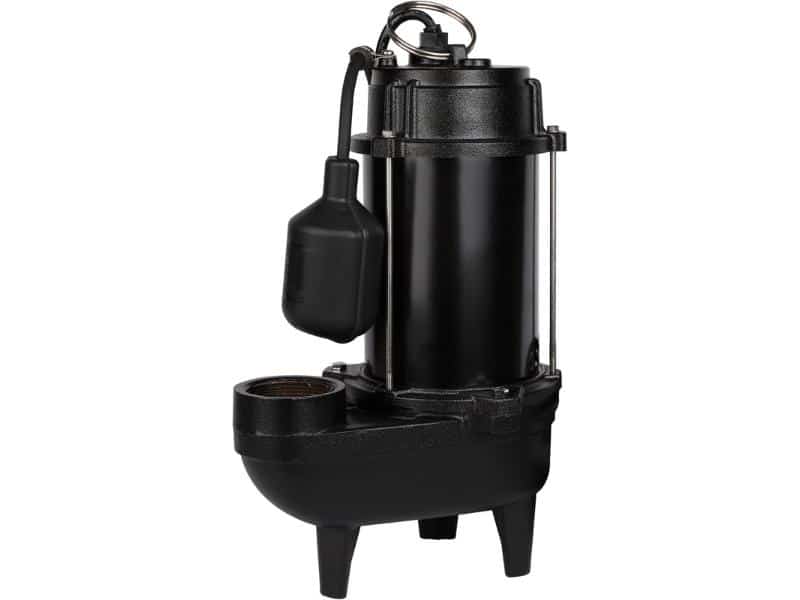
1/2 HP Cast Iron Effluent Pump Tethered Float Switch with 10 foot cord.
Features and Benefits
– High flow effluent pump
– Easily replaces all professional grade tethered pumps
– Heavy duty cast iron volute
– Durable cast iron construction
– Oil-filled permanent split capacitor motor and built-in automatic thermal overload protector
– Integral 10ft piggy back float switch for automatic operation
– Application with up to 3/4″ diameter solids
– 2″NPT discharge
1/2 HP | 120/1 Voltage | 60 HZ | 3450 RPM | 7.8 AMPS | Max Head Ft 28.5
GPH of water at total Ft. of Head
5ft = 4750 GPH | 10ft = 4030 GPH | 15ft = 3170 GPH | 20ft = 2200 GPH | 25ft =1200 GPH
Effluent Pumps
Effluent pumps are used when grey water needs to be moved against gravity in order to reach your septic system or leach field. A common example would be a home with a washing machine or laundry tub in the basement. An effluent pump would be required in this situation because the grey water needs to move vertically against gravity before it can tie into the homes drainage lines. If all of your home’s grey water sits above your leach field, you may not require an effluent pump in your home.
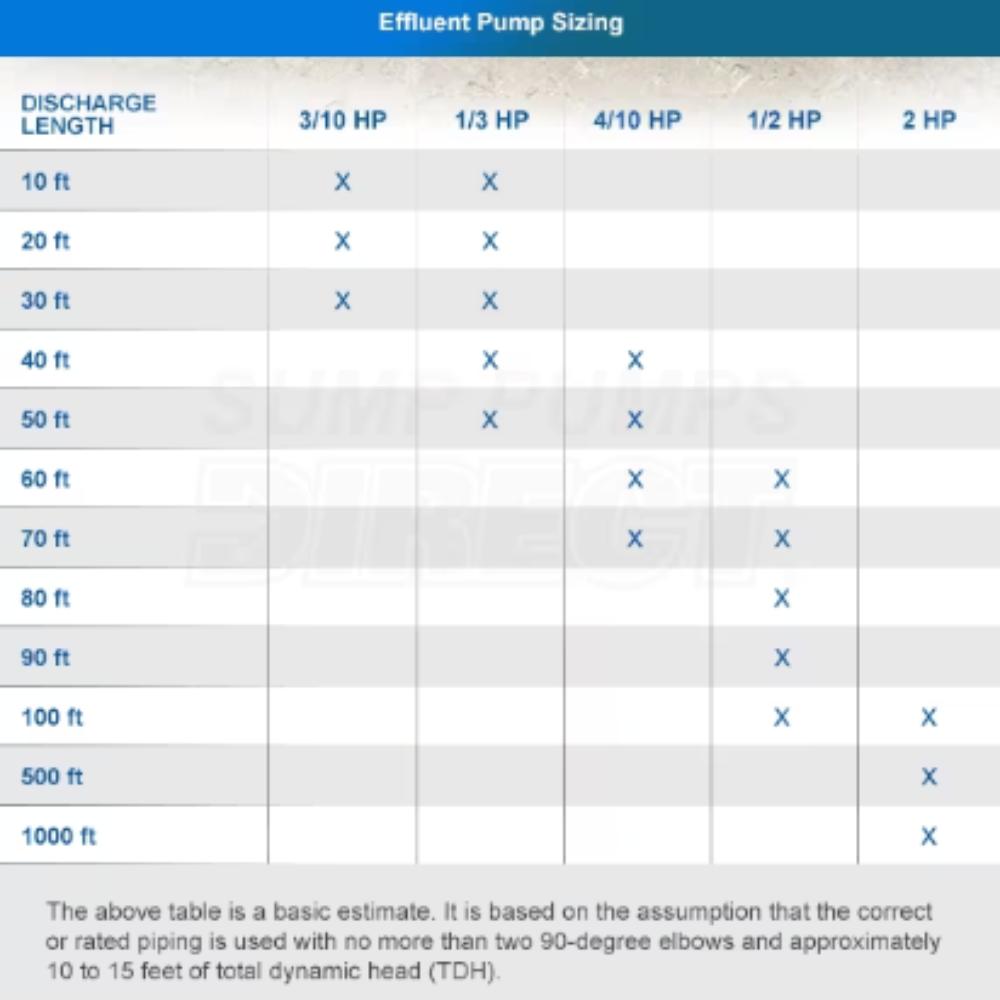
This chart offers a sizing estimate to determine the size and power of the effluent pump needed for your home.
Chart Source sumppumpsdirect.com
Sewage Pumps
Sewage pumps offer a similar function to effluent pumps. However, they are designed to handle solids and sewage materials up to 2” in diameter. Effluent pumps are intended to process a minimal amount of solids, and no more than ½” in diameter. A sewage pump is most commonly installed to process wastewater coming from basement bathrooms. Like effluent pumps, they’re installed when gravity cannot do the job.
Sewage pumps can also have built-in grinders, which help reduce the size of solids passing through your sewage system.
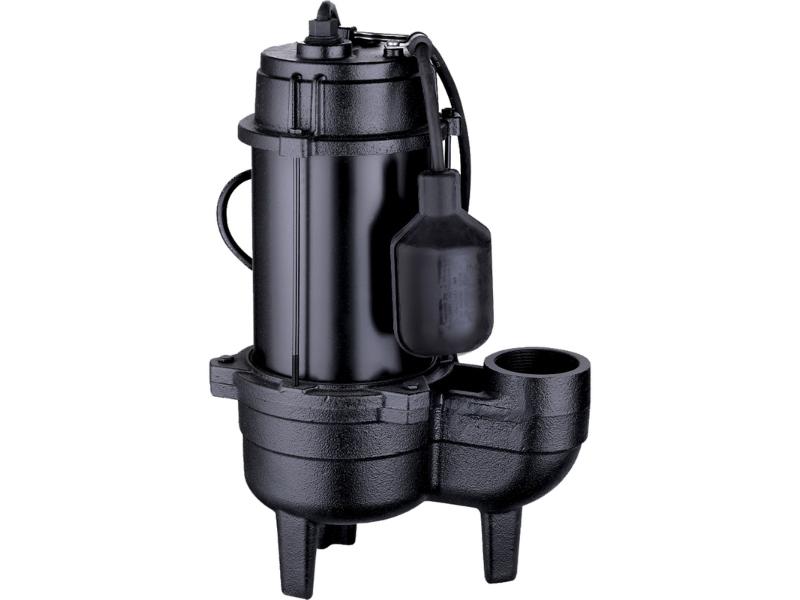
1/2 HP Cast Iron 2″ Sewage Pump with Tethered Float Switch and 10 foot cord.
Features and Benefits
– Durable cast iron construction
– Plastic non-clog vortex impeller
– Oil-filled permanent split capacitor motor and built-in automatic thermal overload protector
– Work with 10ft piggy back tethered float switch for automatic operation
– Application with up to 2″ diameter solids
– Ideal for basements or below grade installations
– 2” NPT discharge capable for handing up to 2″ diameter solids
1/2 HP | 120/1 Voltage | 60 HZ | 3450 RPM | 9.5 AMPS | Max Head Ft 30
GPH of water at total Ft. of Head
5ft = 6400 | 10ft = 5400 GPH | 15ft = 4400 GPH | 20ft = 3600 GPH | 25ft =2700 GPH
Jet Pumps
Jet pumps, also referred to as well pumps, use suction to draw potable water from your well. They’re designed to create enough water pressure for houses, cottages, or irrigation systems.
There are two basic types of jet pumps, shallow well jet pumps and deep well jet pumps. As you may expect based on their names, the depth of your well will determine which pump is right for you. Shallow well jet pumps are designed to work up to 25 feet, while deep well jet pumps can function up to a depth of 200 feet.
Other important factors for selecting your jet pump would be the static level of your well and the recovery rate. Recovery rate is usually measured in gallons per minute. Most wells will have a rating plate installed documenting this information for you.
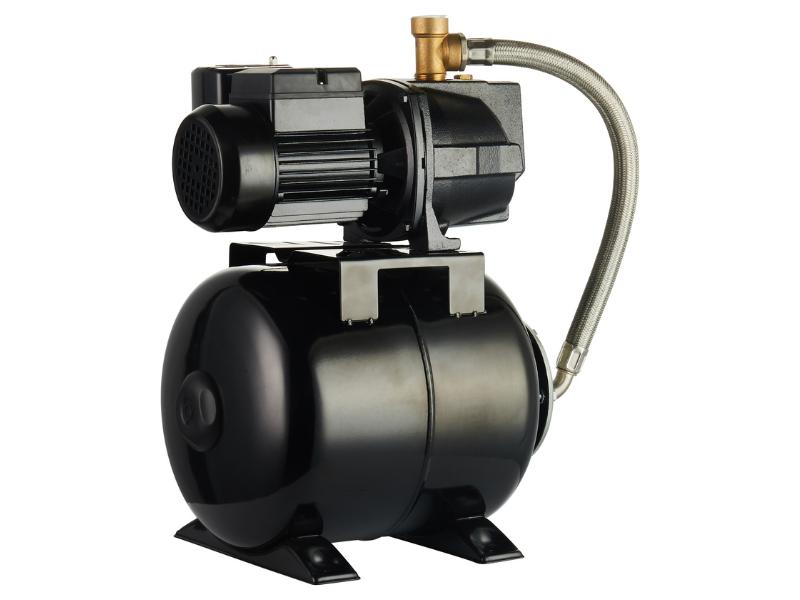
1 HP Shallow Well Jet Pump with 6 Gallon Tank.
Features and Benefits
– Durable cast iron volute
– Built-in automatic thermal overload protector
– Pressure switch is pre-set at 30-50 PSI for automatic operation
– Dual voltage (115V/230V)motor, factory set for 115V
– For use on shallow well applications where wells are 25ft (7.6m) deep or less
– 1-1/4″NPT suction with 1″NPT discharge
– System includes jet pump, pressure switch, pressure gauge, pre-charged pressure
1 HP | 115/230 Voltage | 9.6/4.8 AMPS | 1″ Discharge NPT | Max Head Ft 164
GPH of water at total Ft. of Head 5ft = 1100 | 35ft = 870 GPH | 70ft = 750 GPH | 100ft = 540 GPH | 130ft =310 GPH
Additional pump and plumbing blogs can be found below:
The Perfect Watering Pump For Your Rainwater Harvesting System
The Uses of CSA and Non-CSA Poly Pipe
Prevent Your Jet Pump From Freezing During the Winter


All of these pumps are designed to overcome challenges unique to your property or project. With the help of this guide, we hope you’re feeling better prepared to create a healthy and efficient plumbing system. For customized advice, connect with by phone or email. George has been working in the industry for over 40 years. He specializes in plumbing, HVAC, industrial pipe, valves, and fittings. We’re confident that you won’t find a better combination of product selection and advice for homeowners and plumbers alike.
Whether you’re a plumber looking for a local supplier of high-quality products, or a homeowner taking on a project for the first time, you’re welcome at Ontario Agra.