

Erosion and sedimentation are naturally occurring processes of loosening and transport of soil through the action of wind, water or ice.
These processes may result in an adverse impact on the environment. Such as affecting our water supply, damage to adjacent land, or degradation of aquatic habitat.
Erosion and sediment control techniques are practices that are designed to protect an exposed soil surface. While preventing or reducing the release of sediment to environmentally sensitive areas, while promoting re-vegetation as soon as possible.
At Ontario Agra, we offer a wide range of products to assist with any erosion and sediment control issues including:
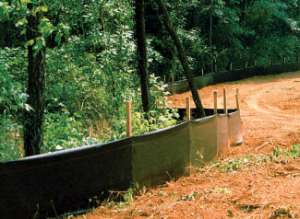
Silt Fence
- A temporary sediment control device made of geotextile stretched between a series of wooden stakes.
- Geotextile is manufactured with UV stabilized, high tenacity polypropylene yarns woven to form a dimensionally stable network.
- Protect waterways from sediment & silt contamination.
- Used For: Along perimeters of construction sites, Below the toe or down slope of exposed and erodible slopes, Along streams and channels, Around temporary spoil areas and stockpiles, Below other small cleared areas.
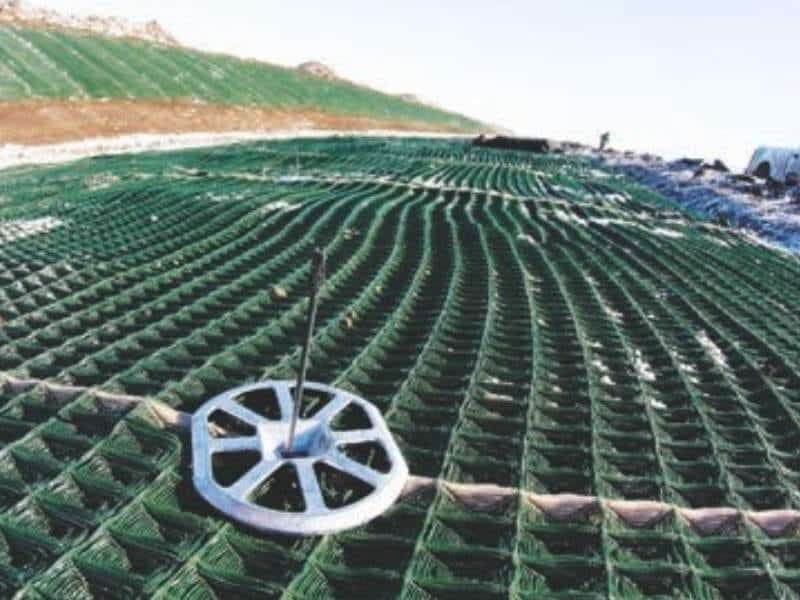
Armormax
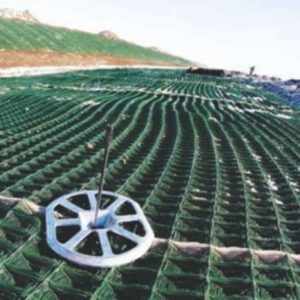
- Flexible and durable armoring system featuring PYRAMAT® woven three-dimensional High Performance Turf
Reinforcement Mat (HPTRM) with X3® fiber technology and Engineered Earth Anchors (EEAs). - Designed for severe erosion and surficial slope stability challenges.
- Suited for arid and semi-arid environments where vegetation densities of less than 30% coverage are anticipated.
- Securely anchors to the subgrade for long-term design life.
- Withstands extreme hydraulic stresses and resists non-hydraulic damage.
- Used For: Slopes, Levees, Arid/semi-arid stormwater channels, Canals, Stream and river banks.
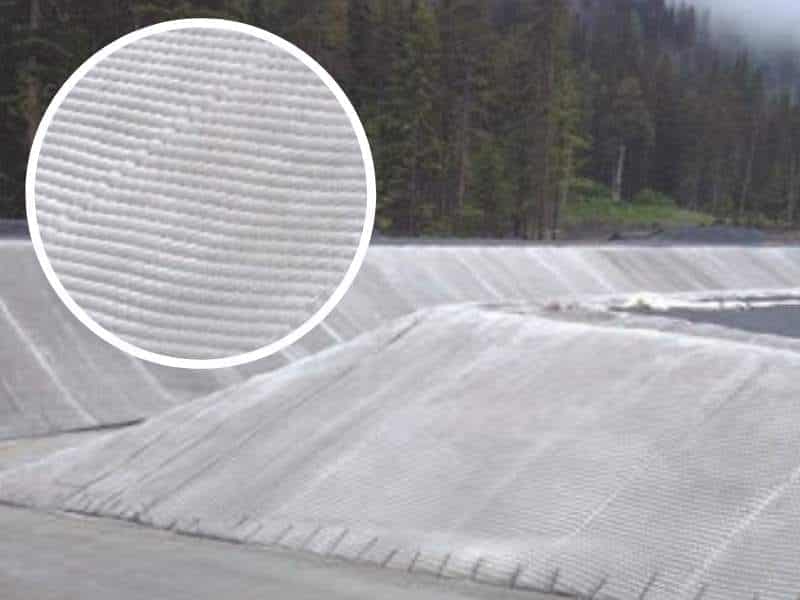
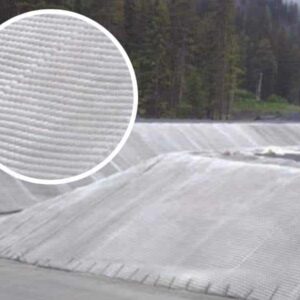
Fabric Formed Concrete Armour
- Slightly dimpled double-wall woven nylon geotextile resembling pocket-like forms pumped with a water rich cement mixture.
- Forms are placed, sewn together with hand held sewing machines then filled.
- Cured cement is encased within fabric creating a final product that is as strong as reinforced concrete.
- Used For: Slope revetments, Landfill containment systems, Holding ponds, Bridge scour repair, Bridge or dock piling reinforcement.
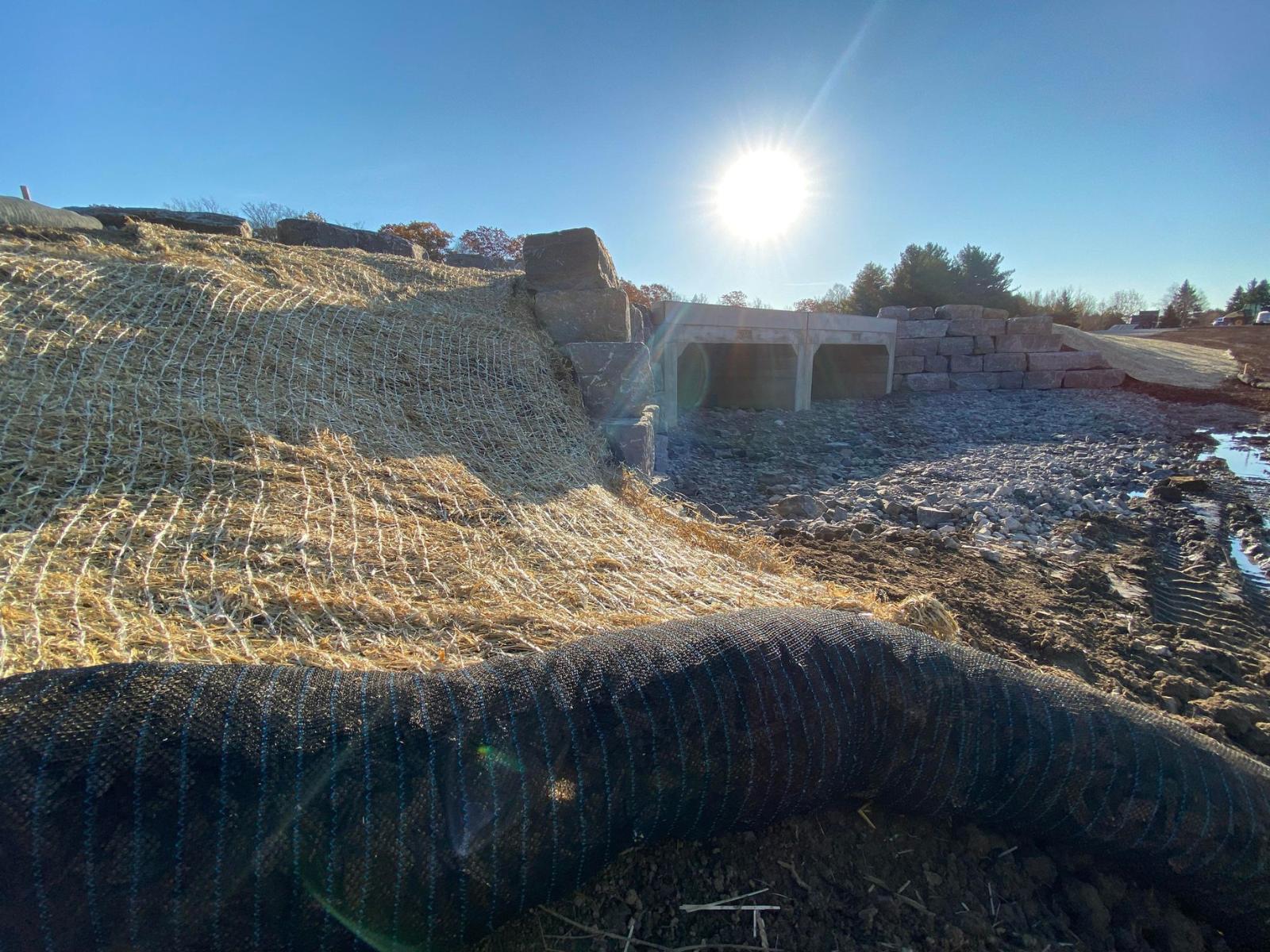
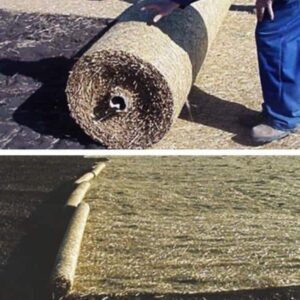
Straw Matting
- Made of various degradable materials, such as straw and coconut, mechanically stitch- bonded to a polypropylene or biodegradable netting structure.
- Supplied in easy to install rolls.
- Used For: Short-term: mild slope and channel applications requiring erosion control for up to 12 months depending on moisture, light, and environmental conditions. Extended-term: extreme slope and channel applications requiring erosion control for up to 36 months depending on moisture, light, and environmental conditions.
One of the best ways you can reduce erosion is by combining straw matting with grass seed. This process stops surface sediment shifting and establishes a root system for long-term stability.
Installation and Grass Seeding Guide
For best results, we recommend spreading grass seed first, then covering your area with straw matting.
Sowing the Seed
Application: Use a broadcast or drop spreader for even coverage, applying half the seed in one direction and the other half perpendicularly.
Quantity: We recommend using 200 lbs of seed per acre when starting a new lawn. For overseeding and improving your existing lawn, this amount can be cut in half. Do your best to apply the same techniques and timing while overseeding as you do with seeding a new lawn.
Seed-to-Soil Contact: Lightly rake the seed into the soil (no deeper than 1/8 to 1/4 inch).
Straw Matting Installation Steps
- Roll out your straw matting to cover your freshly seeded area.
- Use landscape pins, wooden stakes, biodegradable stakes, or rebar to pin your straw matting in place as you unroll it.
Post-Seeding Care
Watering: Keep the seeded area consistently moist but not saturated. Water daily for 7–21 days until germination occurs. One of the major benefits of spring planting is that the increased rain will take care of this for you.
Mowing: Wait until the grass is 7.5–10 cm (3–4 inches) high for the first mow.
Weed Control: Do not apply weed control products until after the new grass has been cut at least 3 times.
Turf Reinforcement Mat
- A permanent, non-degradable, three dimensional matting structure formed of vegetative growth and synthetic materials.
- Designed for use on critical slopes and channels requiring permanent erosion control and turf reinforcement.
- Available in polypropylene, polypropylene/coconut, & polypropylene/straw.
- Supplied in easy to install rolls.
- Used For: Steep slopes, Drainage ditches and channels, Irrigation and storm water ponds, Levees, dams, & dikes. Agricultural applications. Environmental applications.
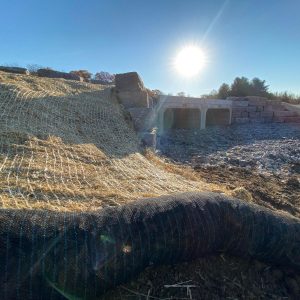
Straw Wattle
- Elongated tube of compacted straw and/or other fibers wrapped in UV stabilized degradable tubular polypropylene plastic netting.
- Used for temporary erosion and sediment control applications.
- Designed to allow runoff/water to penetrate through the fiber while reducing sediment migration.
- Functional longevity is approximately 6-24 months, depending on moisture, light, and environmental conditions.
- Available in 12, 9 or 6 inch diameter.
- Used For: Along the contours or at the base of a slope to help reduce soil erosion and retain sediment. Around catch basin inlets.
Turbidity Curtain
- A geosynthetic barrier made with high strength geotextile or vinyl fabric, equipped with a heavy- duty float and ballast weight chain system that suspends the curtain in the water.
- Works as a shield to protect aquatic ecosystems by stopping solid particles from going into aquatic environments.
- Gives silt and sediment time to settle instead of flowing into other parts of the body of water.
- Available in standard and custom sizes.
- Used For: Waterways near construction sites.
Hydroseeding
- A combination of grass seeds, mulch, water, fertilizer, and more that is spread on bare ground to quickly grow grass and prevent soil erosion.
- More efficient than traditional seeding.
- More uniform look than laying sod or traditional seeding.
Find out more about our selection of ESC products by downloading our brochure! Still searching for the correct geosynthetic? View the rest of our geosynthetic options here.


